
Broken Pieces, Golden Lines
Updated: Apr 4
A conversation with Audrey Lee on art, healing, and discovering beauty through brokenness.
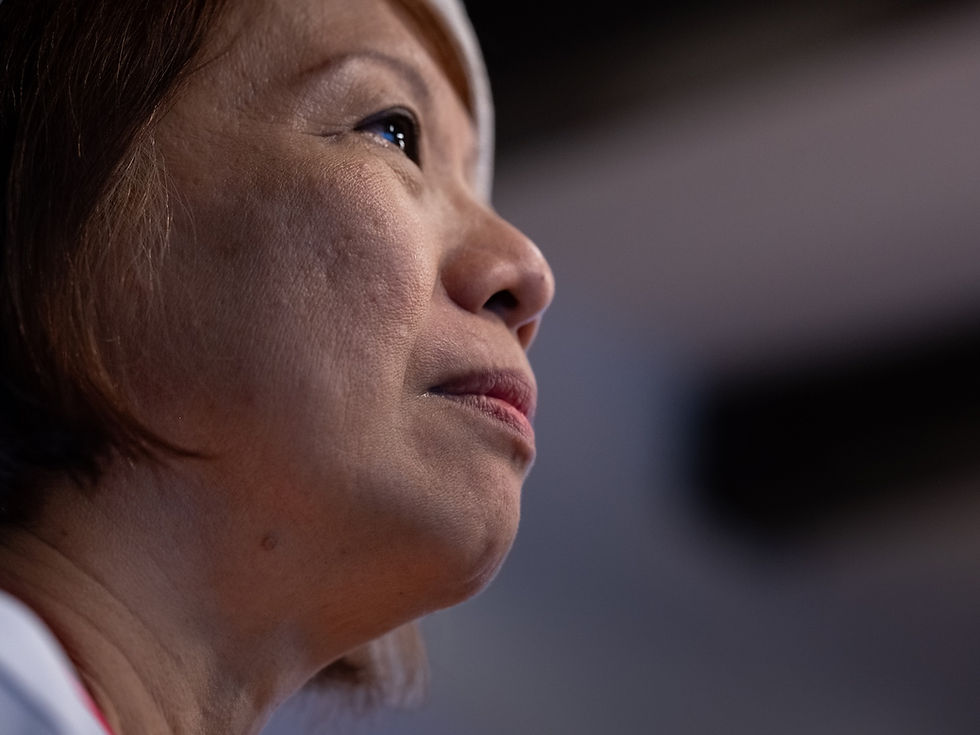
On 21 March 2026, I visited one of Audrey Lee’s Kintsugi workshops.
Participants gather around a table, each holding a ceramic bowl in their hands. For a brief moment there is hesitation, the quiet awareness that the object they are about to break had only seconds ago been whole.
Then the bowls are struck.
The sound of ceramic splitting carries across the table, sometimes followed by laughter, sometimes by a pause as people look down at the fragments they have just created.
Audrey usually lightens the moment with humour.
“The hammer is for the ceramic pieces,” she says with a smile, “not for each other.”
At first the room feels lively, almost playful. But as the pieces settle across the table, the atmosphere begins to shift. Conversations soften and participants lean closer to the fragments in front of them, studying the shapes they have just created.
Watching the workshop unfold, I was reminded how deeply Audrey’s art had already entered my own life.
For the past three years, Audrey has been someone quietly present in my life through her art. At one point, I had three empty frames hanging in my home. Audrey offered to bless them with her paintings and asked what I might want to place in them.

After talking it through, we settled on three flowers: a lily representing faith, a rose for love, and a sunflower for hope.
Those three pieces now hang as the centrepiece of my home, a reminder of the meanings we chose together.
They have remained there ever since, gently reminding me how beauty sometimes speaks without needing many words.
Yet Audrey’s journey into art did not begin the way many people might expect.
Discovering Art Later in Life
Unlike many artists who begin young, Audrey came to art later in life.
For many years she built a successful corporate career, eventually serving in a regional leadership role overseeing corporate real estate across Asia Pacific. Those decades shaped her leadership, discipline, and understanding of people.
Art was not originally part of that path.
It entered her life gradually and soon became a place where reflection and creativity could meet. What began as curiosity slowly grew into a way for her to give shape to stories, emotions, and faith through visual form.
Today Audrey often describes art not simply as a craft, but as a way of helping people see their own journeys from a different perspective.
Much of that perspective now finds its way into the workshops she leads.
Turning Points

Through these workshops Audrey began noticing something about art.
It often reaches places words cannot.
Participants are not asked to produce perfect drawings or polished pieces. Instead they are invited to explore.
Through clay, colour, and reflection, people sometimes begin to see their own experiences differently.
Some arrive carrying grief.
Others come curious, unsure of what to expect.
Some simply come to try something new.
Occasionally a quiet shift appears when someone begins to recognise their own story in a different light.
For Audrey, those moments are the most meaningful.
The Kintsugi Table
Among the workshops Audrey leads, Kintsugi has become one of the most distinctive.
The process begins simply. Each participant receives a ceramic bowl and breaks it intentionally before beginning the careful work of putting the pieces back together.

Fragments are arranged and edges aligned while gold lacquer slowly fills the cracks.
The work requires patience.
Sometimes the pieces do not fit the way participants expect. Occasionally a fragment is missing altogether. Yet these moments often lead to reflection rather than frustration.
Kintsugi does not try to hide the cracks.
It honours them.
For Audrey the broken bowl becomes a quiet metaphor for life.
Every person encounters moments of fracture: disappointment, loss, mistakes, seasons when things fall apart.
Repair, like the work happening at the table, rarely happens quickly.
And sometimes what is restored carries a different kind of beauty.
What Happens Around the Table

As participants begin working with the fragments in front of them, attention shifts from the act of breaking to the work of restoration.
Edges are examined carefully as people try to understand how the pieces might return to one another. Gold lacquer is applied slowly, and the bowl begins to take shape again through a process that cannot be rushed.
In that careful concentration people often begin reflecting on their own experiences.
Occasionally someone shares a story across the table. At other moments the room remains quiet as participants continue working, absorbed in the delicate process of repair.
By the time the bowls begin to resemble their original form again, the exercise has become something more than a craft.
For many participants the fragments in front of them begin to resemble parts of their own stories.
The Beauty of the Broken
The idea behind Kintsugi is simple.
Broken objects are not discarded. They are restored, and the cracks are not hidden but filled with gold.
The repaired piece carries visible traces of its past, yet those lines gradually become part of its beauty.
Life rarely moves in perfect lines.
Most lives carry their own fractures, not always the kind others can see but the kind that quietly shape the way we move through the world.
Sometimes it is around those very lines that repair slowly begins.
“The cracks are for our light to shine through.”
Audrey Lee
Hope & Reflection
By the end of a Kintsugi workshop the bowls rarely resemble what they once were.
Gold lines move across their surfaces, marking the places where the fractures once appeared.
They are not perfect.
But they are whole again.
The gold does not hide the break.
It shows that something damaged has been carefully restored.
And within that quiet repair a different kind of beauty begins to appear.
To explore these ideas more deeply, I asked Audrey to reflect on several questions about her journey into art, the meaning behind the Kintsugi workshops she now leads, and what she has observed from the people who gather around her table.
What follows is a conversation about art, healing, and the quiet ways brokenness can reveal beauty.
A Conversation with Audrey Lee
BEGINNINGS
1. When did art first become something meaningful in your life?
Art entered my life later than most. For decades, I worked in global corporate real estate leadership, where precision and discipline shaped my days. It was only after stepping away from that world that I discovered art as a language of reflection. What began as curiosity grew into a way of listening to my own story and expressing faith, hope, and love in visual form.
2. Your work often carries themes of faith, hope, and love. How did these themes begin to shape the way you create and share your art?
Faith steadies us, love sustains us, and hope carries us forward. They remind me that art is more than technique; it is a way of embodying what sustains us. A lily for faith, a rose for love, a sunflower for hope. These symbols became part of my practice, and they continue to guide how I share art with others.
THE LANGUAGE OF ART
3. Many people see art as something visual, but artists often experience it differently. When you paint or create, what are you usually listening for inside yourself?
I listen for silence, the still, small voice. That quiet space where emotions and stories rise without words. Sometimes it is grief, sometimes joy, sometimes prayer. Art becomes a way of giving those inner stirrings shape, colour, and meaning.
4. Some of your work now involves teaching others through workshops. What have you discovered about people when they begin creating something with their own hands?
When people create with their own hands, they often discover courage. Many arrive saying, “I’m not an artist.” Yet as they shape clay or brush colour, they begin to see themselves differently. The process is less about perfection and more about permission. Permission to explore, to express, to heal. Creativity, I believe, is the primary language of the heart.
KINTSUGI AND BROKENNESS
5. In your Kintsugi workshops, participants intentionally break ceramic pieces before repairing them. What do people usually feel in that moment when something they are holding breaks?
There’s often laughter mixed with hesitation. Breaking something feels unnatural. Participants feel strange being given permission to destroy. Yet once the pieces scatter, there is shock, even bewilderment at the chaotic mess. That is when they begin to realise that brokenness can be the beginning of something new and unique.
6. Kintsugi repairs broken pottery with gold rather than hiding the cracks. What do you think this teaches us about the way we often view our own brokenness?
It teaches us that cracks are not flaws to be concealed. They are part of our story. When illuminated, they become places of beauty and strength, badges of honour and tributes to our courage in overcoming difficulty.
7. You once shared a reflection during a workshop about how objects can be replaced, but a person’s heart is harder to repair. What led you to that realisation?
Watching participants handle broken bowls reminded me how fragile we are. A bowl can be glued back together, but a wounded heart takes time, patience, and grace. That contrast deepened my conviction that healing is sacred work.
I also realised that sometimes we are the cause of pain to others, especially to our loved ones. How then can we become the “glue” that helps our child heal from the emotional cracks we ourselves may have hammered?
Another sobering realisation came from statistics in Singapore: 25% of young adults struggle with poor mental health, 40% of caregivers are at risk of depression, and 82% of people avoid professional help for stress. Sharing this awareness compels us to reduce caustic remarks and instead be intentional in speaking comfort and encouragement.
HEALING AND RESTORATION
8. When people sit at the Kintsugi table, they are often quiet and focused. Have you noticed moments where the craft becomes something deeper than simply repairing a bowl?
Yes. The silence often becomes a time of mindfulness. As gold fills the cracks, participants begin reflecting on their own fractures. The bowl becomes a mirror of their life, and the act of repair becomes a meditation on restoration. Many describe the session as therapeutic, calming, and deeply reflective, a tangible way to embrace brokenness and restore hope.

9. What have these workshops taught you about how people carry their own wounds or struggles?
They’ve taught me that everyone carries something unseen. Some wounds are fresh, others long hidden. Art provides a safe space where those burdens can be acknowledged without words, and sometimes gently released. Knowing there is “glue” to heal our emotional wounds and eventually bring out the “gold” reminds us that every experience can be turned for good.
FAITH AND ART
10. Your workshops often bring together art and faith in a very natural way. How do you see creativity helping people encounter deeper parts of their lives or their faith?
Creativity opens doors that words cannot. A brushstroke, a broken bowl, a golden line. These metaphors help people encounter grace, forgiveness, and hope in ways that feel tangible. One participant summed it up beautifully: “Brokenness can be embraced and turned into something beautiful.”
11. Do you think brokenness changes how we see beauty?
Absolutely. Beauty without brokenness can feel distant, idealised. But when we see beauty emerge from fracture, it becomes real, human, and deeply moving. It is about learning to believe in the nuggets of gold buried in hidden darkness.

HOPE AND REFLECTION
12. If someone sitting at your workshop table feels that their life has been fractured or broken in some way, what would you want them to know?
I would want them to know that brokenness is not the end of their story. Just as gold fills the cracks of a bowl, grace can enter the fractures of our lives and reveal unexpected beauty. As Viktor Frankl reminds us, discovering one’s meaning in life gives us the will to live.
13. When you look at a repaired Kintsugi piece, what does it remind you about life?
It reminds me that wholeness does not mean perfection. Life carries scars, but those scars can become places of strength and light. The cracks remain for a purpose, to let our light shine through.
14. At this point in your journey, what are you most grateful for?
I am most grateful for the people I’ve met along the way, those who have shared their stories, trusted the process, and discovered beauty in brokenness. Their courage and hope continue to inspire me.
This story is part of the Made In His Image journal, a collection of human stories exploring gratitude, hope, and the quiet dignity of everyday lives.
Made In His Image
You are made perfectly. Loved deeply. Never beyond hope.
Visit the Made In His Image project at: madeinhisimage.life


Comments